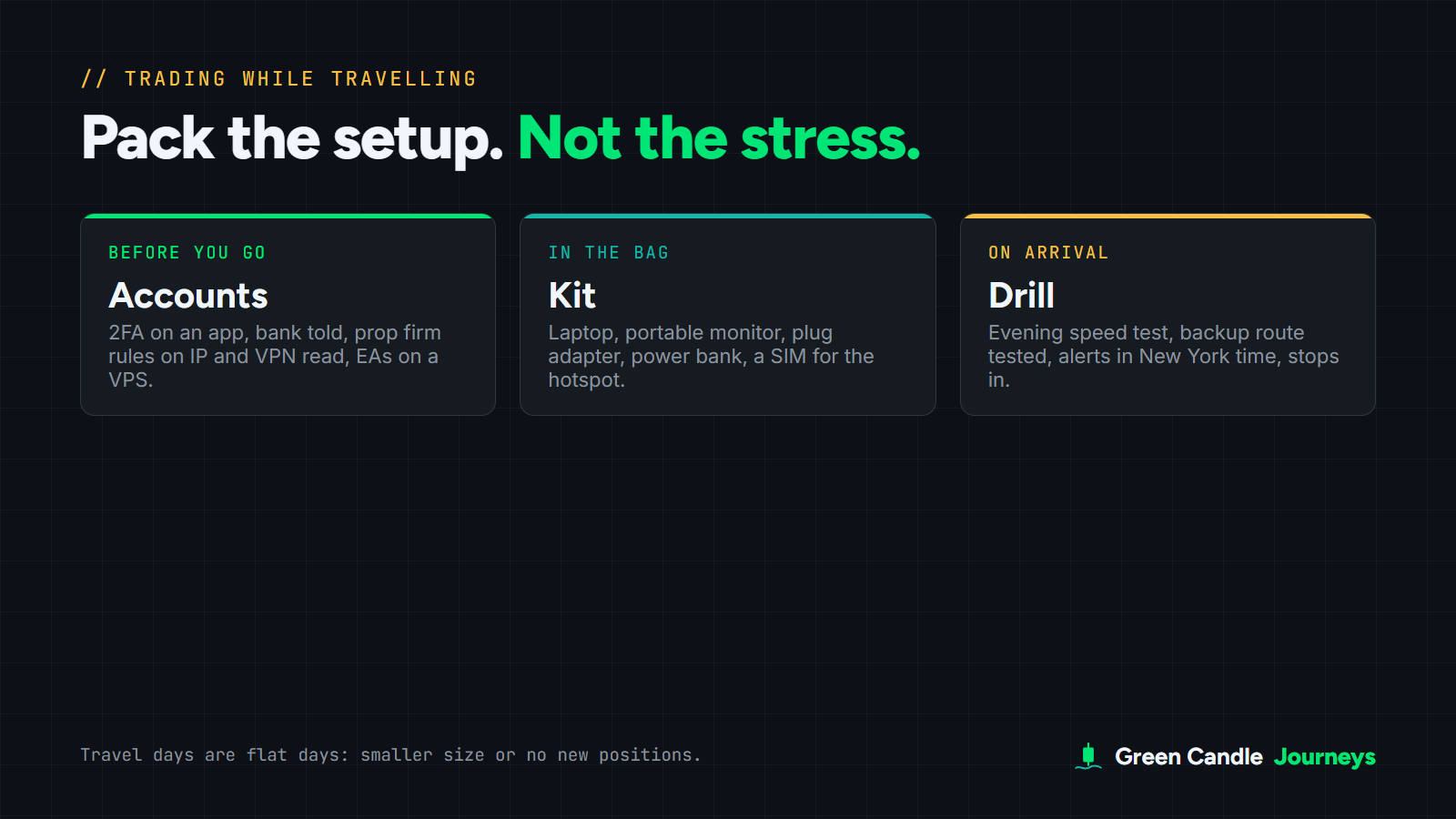
Can you really trade while travelling?
Yes. Brokers and platforms work from anywhere with internet. The risks are practical, not technical: connection, login access, prop firm rules and your own energy across time zones.
Almost every problem traders hit on the road comes from something that could have been checked at home. That's what this list is for.
| Risk on the road | What it looks like | The fix |
|---|---|---|
| Connection | Hotel Wi-Fi drops at the open | Second route: hotspot on a local SIM |
| Login access | 2FA code goes to a phone that's off | Authenticator app and backup codes |
| Account rules | Prop firm flags a new IP or VPN | Read the terms; tell support where you'll be |
| Automation | EA stops when the laptop sleeps | VPS near your broker's server |
| Energy | Trading jet-lagged at 02:00 | Light days around travel |
What should I set up before I leave?
Four things, at home, while everything still works: 2FA on an authenticator app with backup codes, your bank told you're travelling, your prop firm's rules read, and any automation moved to a VPS.
- 2FA: move broker, exchange and prop firm logins from SMS to an authenticator app. Save backup codes in your password manager.
- Bank: warn the bank whose card funds your trading. A burst of foreign transactions can freeze it, and unfreezing it often needs an SMS. More in money in Vietnam for traders.
- Prop firm rules: see the next section.
- VPS: EAs and copy trades go on a VPS in the same region as your broker's server, so a sleeping laptop or dropped line doesn't stop them.
- Test login: log in once from a different network at home (a phone hotspot is enough) and note if your broker asks for extra verification.
Do prop firms let you trade while travelling?
Many do, but the rules differ by firm. Some restrict VPNs or VPS use, some flag logins from new countries or sudden IP changes, and a few restrict certain countries entirely.
Read your firm's terms before you book, not after a payout is held. If anything is unclear, email support with your dates and destination and keep the reply. A phone hotspot on a local SIM gives you a normal local IP, which is usually cleaner than a VPN for this reason. We cover VPN, IP and device rules in more detail in a coming guide.

What should a trader pack?
A laptop and charger, a universal plug adapter, a power bank, a phone that can run a hotspot, and a portable monitor if you trade more than one chart. For long stays, add a small UPS for the router.
| Item | Why | Must or nice |
|---|---|---|
| Laptop + charger | Your terminal | Must |
| Universal plug adapter | Sockets vary; Vietnam uses mostly A and C types | Must |
| Phone with hotspot | Second internet route on a local SIM | Must |
| Power bank | Keeps the hotspot alive; carry-on only on flights | Must |
| Portable monitor (USB-C) | Chart plus execution window side by side | Nice |
| Mini UPS for the router | Rides through short power cuts | Nice for long stays |
| Wired mouse, ethernet cable | Fewer things to charge; plug into the room line | Nice |
For the non-trading side of the bag, our sister site's Vietnam packing list covers clothes, plugs and the weather by month.
How do I stay connected on the road?
Run two independent routes: the room's fibre as the main line and a phone hotspot on a different network as the backup, with your broker's app and stops in the market as the last resort.
Ask the hotel for an evening speed test before you book, and check whether the building has a generator. In Vietnam, pick a local SIM on a different network from the hotel's fibre; the full setup is in our eSIM and SIM guide for traders, and the power and VPS side in trading from Vietnam.
How do I handle session times in a new time zone?
Set every alert in New York or London time, not local time, and write down the four times that matter in your destination: London open, New York open, US data and the FOMC statement.
Time zones and daylight-saving changes are where travellers get caught. Our country guides do the maths for you: Vietnam, Malaysia, the Philippines and Indonesia, each with a live converter. If you're choosing where to go, the best places in Asia to trade compares how late each night runs.
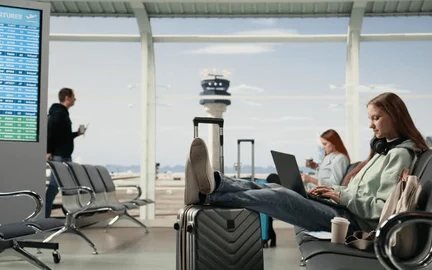
Should I trade on travel days?
Many traders treat travel days as light days: no new positions, or smaller size, because airports, flights and jet lag leave you tired and offline at unpredictable times. It's a personal rule, and it's easiest to keep if you decide it before you leave.
- Check whether a big release (NFP, CPI, FOMC) falls during your flight, and plan around it.
- Make sure every open position has a stop that works without you.
- Give yourself the first evening to sleep. Our sister site's jet lag guide for Vietnam has the practical side; for the trading side, see trader burnout and a reset.
FAQ
Can you trade forex while travelling?
Yes. Most brokers and platforms work from anywhere with internet. The risks are practical: losing your connection, losing access to login codes, a prop firm flagging a new IP address, and trading tired across time zones. A checklist before you go handles most of them.
Do prop firms allow you to trade while travelling?
Many do, but rules differ. Some restrict VPNs, VPS use or logins from certain countries, and some flag a sudden IP change. Read your firm's terms and, if unsure, tell their support where you'll be before you travel.
Should I use a VPN when trading abroad?
A VPN protects you on hotel and café Wi-Fi, but some brokers and prop firms treat VPN logins as a risk flag. Check your firm's rules first. A phone hotspot on a local SIM is often a cleaner way to avoid public Wi-Fi.
What equipment do I need to trade while travelling?
A laptop and charger, a plug adapter, a power bank, a phone that can run a hotspot, and ideally a portable monitor. A small UPS for the router is worth it for longer stays where power cuts are common.
Should I trade on travel days?
Many traders treat travel days as light days: no new positions, or smaller size, because airports, flights and jet lag leave you tired and offline at unpredictable times. It's a personal rule worth setting before you leave.
The bottom line
Secure your logins, read your prop firm's rules, put automation on a VPS, pack a second internet route, and run a ten-minute drill on arrival. Do that and the trip costs you nothing but a few late nights you chose yourself.
Next: visa rules for Vietnam, or a month in Da Nang.
Broker and prop firm rules change and differ by firm. Nothing here is financial advice.