Should I bring cash or a card to Vietnam?
Both, but lean on cash. Take dong out of ATMs with a debit card, pay by card where you'd expect it at home, and use cash for everything with plastic stools. You don't need to bring US dollars.
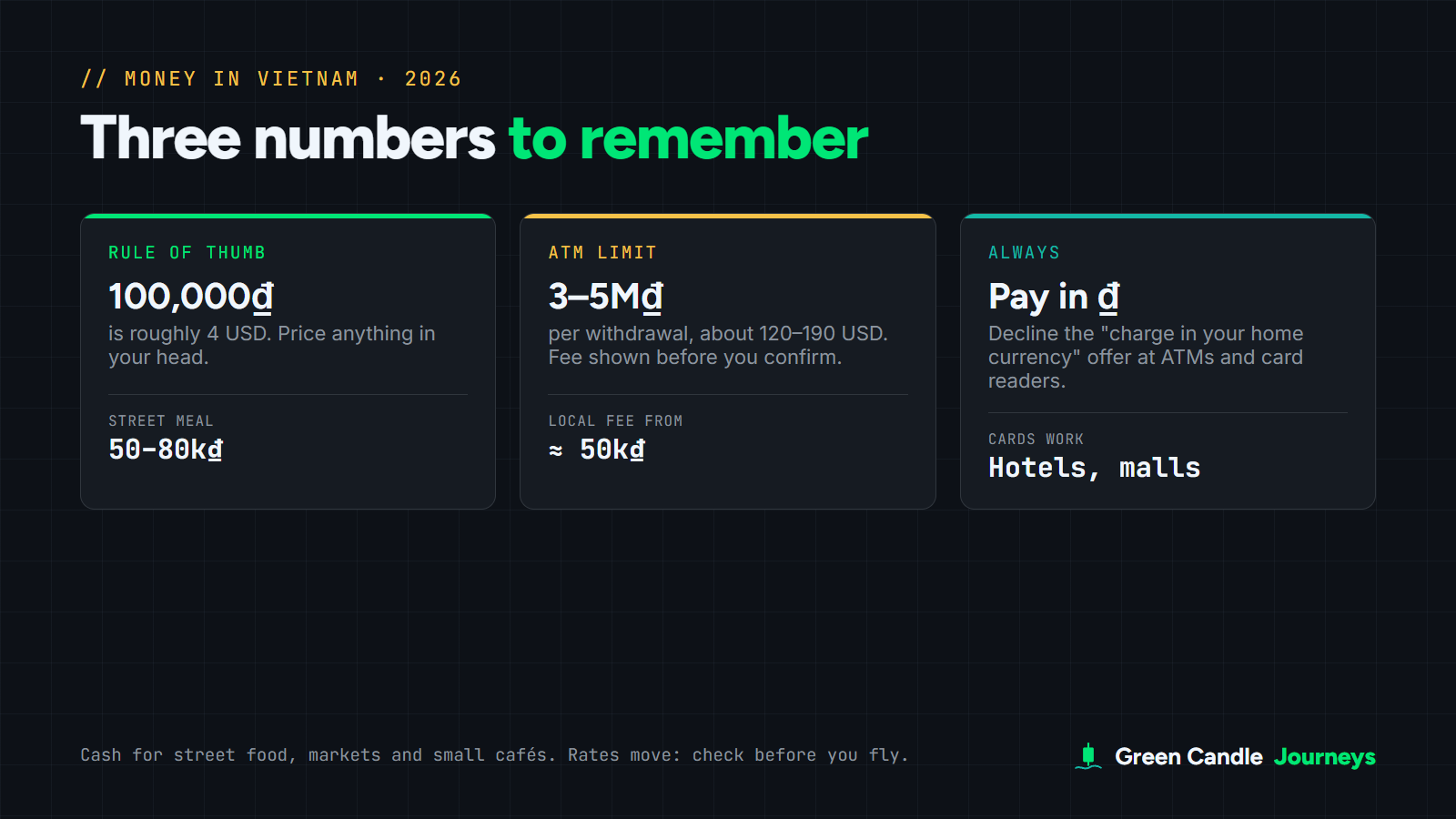
The currency is the Vietnamese dong (VND, ₫). Notes go up to 500,000, and the zeros look alarming for about ten seconds. Hold on to one number, 100,000 dong is roughly 4 USD, and you can price almost anything. Watch the 20,000 and 500,000 notes: both are blue.
What does a trader's day cost in Vietnam?
Less than most traders expect: coffee under a dollar, a street meal for 2–3 USD, a cross-town Grab for a few dollars, and a comfortable mid-range room for roughly 30–60 USD a night.
| Item | Rough price (2026) | Pay with |
|---|---|---|
| Street-side coffee | 15,000–25,000₫ | Cash |
| Street-food meal with a drink | 50,000–80,000₫ | Cash |
| Short Grab or taxi ride in the city | 35,000–100,000₫ | App card or cash |
| Local SIM, 30 days | 100,000–250,000₫ | Cash or card at the store |
| Mid-range hotel room, per night | 700,000–1,500,000₫ | Card |
| Coworking desk, monthly (Da Nang) | ≈ $60–150 | Card or transfer |
Indicative ranges, not quotes. Prices vary by city and by how touristy the street is.
How do ATMs work in Vietnam?
Most machines give 3 to 5 million dong per withdrawal, about 120 to 190 USD, with a local fee from around 50,000 dong shown on screen before you confirm. Your own bank's fee comes on top.
- Always pick dong. If the machine offers to charge you in your home currency, decline. The conversion it offers is rarely in your favour. The same goes for card readers in shops and hotels.
- Use bank-lobby machines, not a lone ATM down a tourist alley. Banks such as VPBank, VIB and Shinhan often come up as cheaper options.
- Take out what you need before heading into the mountains; ATMs thin out fast around Sapa and Ha Giang.
How do I keep my trading money safe while I travel?
Separate it from your travel money. Tell your bank you're travelling, keep the card that funds your broker, prop firm or exchange at the hotel, and do deposits and withdrawals only on a connection you trust.
- Warn your bank before you fly. A card that pays for prop firm challenges, broker deposits or chart subscriptions can be blocked by a sudden burst of foreign transactions, and unblocking it often needs an SMS to your home number. Keep that number active, as in our eSIM and SIM guide.
- Carry two cards from two banks, in different places. If one is swallowed by an ATM or frozen, the trip goes on.
- Leave the trading card in the safe. Pay for coffee with a travel card; if it's skimmed, your trading accounts aren't touched.
- Move money on your own connection, not café Wi-Fi. Use your hotspot or a VPN for broker logins and transfers.
- Plan big transfers before you go. Funding or withdrawing large amounts mid-trip invites extra checks. We don't cover moving trading profits or crypto into Vietnam here; those rules are specific, so use regulated channels and take proper advice.
Can I pay by QR code like the locals?
Usually not. The QR codes everyone scans are tied to Vietnamese bank apps, and visitors generally can't pay them from a foreign app. Where you'd see locals scanning, have small notes ready.
For getting around, a ride-hailing app such as Grab or Xanh SM fixes the price before you ride and takes a card in the app, which removes most money arguments. Our sister site explains how to pay for Xanh SM rides in cash or by card.
Do I need to tip in Vietnam?
No. Tipping isn't a habit in Vietnam, and nobody expects it. Small change at cafés is plenty, and a private guide or driver is where most visitors give more.
Some upmarket restaurants and hotels add a service charge; if yours has, you're done. A spa therapist is happy with 100,000 to 200,000 dong. Hand money over with both hands; it's a small gesture that lands well. The full guide to cash, cards and tipping is on Vietnam Pickleball Travel.
FAQ
Should I bring cash or a card to Vietnam?
Both, but lean on cash. Use a debit card to take Vietnamese dong out of ATMs, pay by card in hotels, malls and proper restaurants, and use cash for street food, markets, small cafés and taxis. You don't need to bring US dollars.
How much can I withdraw from an ATM in Vietnam?
Most machines cap each withdrawal at 3 to 5 million dong, roughly 120 to 190 USD. Each withdrawal carries a local fee, often from around 50,000 dong, shown on screen before you confirm, on top of your own bank's charges.
How much is 100,000 dong?
Roughly 4 US dollars. The exact rate moves, so check it before you fly, but 100,000 dong is about 4 USD is a reliable rule of thumb for pricing things in your head.
Can I use QR code payments in Vietnam as a visitor?
Generally not. The QR codes everyone uses are linked to Vietnamese bank apps, and visitors usually can't pay them from a foreign banking app. Carry cash for places that would normally take QR.
Should I tell my bank I'm travelling to Vietnam?
Yes, especially if the same card pays for broker deposits, prop firm challenges or trading subscriptions. A sudden run of foreign transactions can trigger a block, and unblocking it from abroad often needs an SMS code sent to your home number.
The bottom line
Dong in your pocket, a debit card for ATMs, always pay in dong, and keep the card that funds your trading in the hotel safe. Sort your bank and your SMS codes before you fly, and money becomes the easiest part of the trip.
Next: where to base yourself in Vietnam this November, or a month in Da Nang.