Should a trader use an eSIM or a local SIM in Vietnam?
Use both. A local SIM gives you cheap data and a real backup line on a Vietnamese network, and keeping your home SIM active means broker, exchange and bank codes still reach you. Most recent phones hold one eSIM and one physical SIM at once.
A tourist going sightseeing can pick either and be fine. A trader is different: you need a second, independent route into the market for the moment the hotel line drops mid-session, and you need your 2FA codes. That changes the answer.
| Option | What you get | For a trader |
|---|---|---|
| Travel eSIM (Airalo, Holafly, Saily…) | Data only, set up at home before you fly | Easiest to set up; usually data only with no local number. Good as a third route |
| Local tourist SIM | Big data allowance, a +84 number, hotspot usually allowed | Your backup line. Pick the network that isn't your fibre's |
| Home SIM (roaming) | Your normal number | Keep it on for SMS login codes only; roaming data is expensive |
Which network should I pick as a backup?
The best backup network is the one your fibre doesn't use. If the hotel or apartment line is Viettel, take a Vinaphone or Mobifone SIM, and the other way round. One local fault then can't take out both routes.
- Viettel has the widest network, with the best reach in mountains and rural areas. If your trip includes Da Lat back roads, Sapa or long drives, it's the safe pick.
- Vinaphone and Mobifone are fast in the cities and the main tourist areas, and many travel eSIMs ride on them.
- 5G is live in the big cities on all three. 4G is plenty for a trading platform; the platform itself uses very little data.
Ask the front desk which provider the building's internet comes from. Most staff know, and the router label usually says.
How much does it cost?
Data is the cheapest part of your trip: about $4–10 for a 30-day local SIM and $5–25 for a travel eSIM, as of 2026. Prices move a little between shops and months.
| Item | Rough price (2026) | Notes |
|---|---|---|
| Local tourist SIM, 30 days | 100,000–250,000 VND (≈ $4–10) | Often ~2GB a day, some call minutes |
| Short data SIM, about a week | Very little | Fine for a short trip |
| Travel eSIM | ≈ $5–25 | "Unlimited" plans slow down after a daily cap |
| Registered SIM delivered to your hotel (our team) | ≈ $12–18 | Registration and delivery included |
For cards, cash and ATM fees, our sister site has a full guide to money in Vietnam.
How do I keep getting broker and bank login codes?
Keep your home SIM active in the phone so texts still arrive, and check with your carrier that SMS works while roaming. The safer fix is to move broker and exchange logins to an authenticator app before you leave.
- Do it at home, while the old number still receives codes. Setting up 2FA from a hotel room with no SMS is how traders lock themselves out.
- Save backup codes for your broker, prop firm dashboard and exchange in your password manager.
- Log in once from Vietnam before the first session you care about. Some brokers flag a new country and ask for an extra check.
What is the 2026 rule about moving SIM cards?
Since 15 April 2026, moving a registered Vietnamese SIM to a different phone can trigger a face re-verification. If it isn't done, the network can cut outgoing calls and texts within hours and later suspend the line.
This one bites traders more than tourists, because we're the ones carrying a spare phone or a 4G router. Decide on day one which device holds the SIM for the whole trip and let the shop put it there. The rule is written about phones; we haven't seen how it treats pocket routers, so don't swap mid-trip either way. Travel eSIMs from overseas companies aren't affected. If something goes wrong, any official Viettel, Vinaphone or Mobifone store can fix it with your passport.
Should I buy a SIM at the airport?
You can, but after a long flight it's a slow queue and a wall of packages you can't compare. Buying in town or having one delivered is easier. You'll need your passport, because every SIM is registered to a named person, and your phone must be unlocked.
If you do buy at the airport, use the network's own counter, not a stall near the exit, and test data and hotspot before you walk away. The full walkthrough, including Zalo and the apps worth installing, is in our Vietnam eSIM and SIM card guide on Vietnam Pickleball Travel.
How do I test the backup before London opens?
Run a five-minute drill on your first afternoon: switch off the room Wi-Fi, connect the laptop to the phone hotspot, open the platform and check the ping, then switch back.
- Do it at the time you'll actually trade. Networks are quiet at 10am and busy at 20:00.
- Keep the phone on charge while it's a hotspot; it drains fast in the heat.
- If you run EAs or copy trades, put them on a VPS so a dropped line doesn't stop them. Our trading-from-Vietnam setup guide covers VPS, power and UPS.
Do I need Zalo?
On a short, fully arranged trip, no. If you're staying a month or more, yes: drivers, small hotels, landlords and cafés run on Zalo, and it verifies new accounts by text, which is easiest with a Vietnamese number. Set it up early in the trip. Planning a longer stay? Start with Da Nang for traders.
FAQ
Should a trader use an eSIM or a local SIM in Vietnam?
Ideally both. A local tourist SIM gives you cheap data and a hotspot backup on a Vietnamese network, while keeping your home SIM active means broker and bank login codes still reach you. Many phones hold one eSIM and one physical SIM at the same time.
Which mobile network is best in Vietnam?
Viettel has the widest coverage, especially in the mountains and countryside. Vinaphone and Mobifone are fast in the cities and tourist areas. For a trading backup, the best network is simply a different one from the network your hotel or apartment fibre runs on.
How much does a SIM card cost in Vietnam?
A 30-day local tourist SIM costs roughly 100,000 to 250,000 VND (about 4 to 10 USD) in 2026, often with around 2GB a day. Travel eSIMs bought online cost roughly 5 to 25 USD depending on data and days.
Can I move my Vietnamese SIM to another phone?
Avoid it. Since 15 April 2026, moving a registered Vietnamese SIM to a different phone can trigger a face re-verification, and outgoing calls and texts can be cut within hours if it isn't completed. Put the SIM in the device you'll use for the whole trip on day one and leave it there.
Will I receive broker 2FA codes in Vietnam?
Codes sent by SMS go to your home number, so keep your home SIM active in your phone (as a physical SIM or eSIM) and check with your carrier that it can receive texts while roaming. Better still, switch your broker and exchange logins to an authenticator app before you fly.
The bottom line
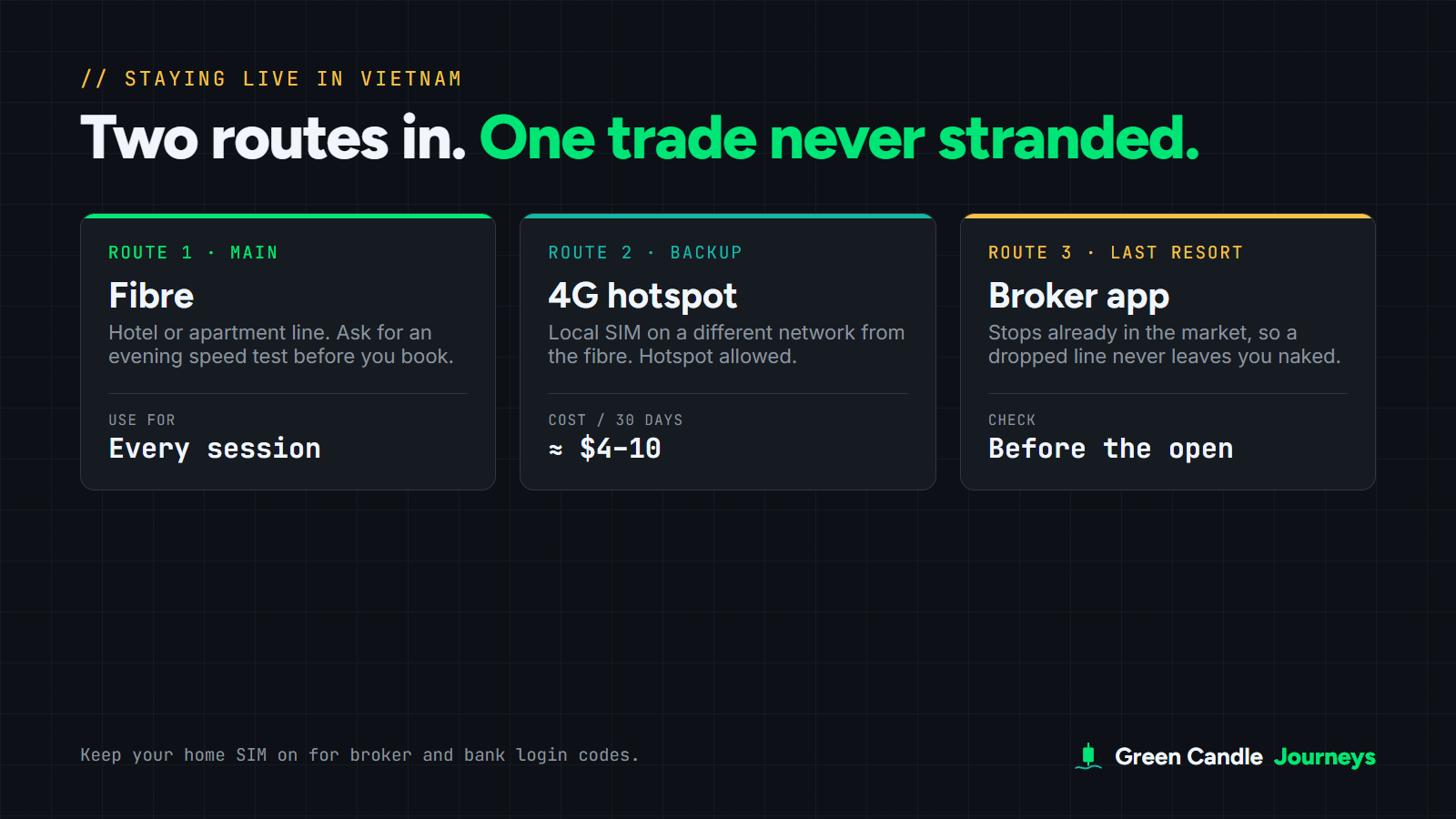
Fibre for the session, a local SIM on a different network as backup, the broker app with stops in the market as the last resort, and your home number on for codes. Set it up on day one, test it at session time, and never move the SIM mid-trip.
Next: forex market hours in Vietnam, or compare bases in the best places in Asia to trade.