Is it good to take a break from trading?
For many traders, yes. Long screen hours, late sessions and a run of losses wear down decision-making, and a planned break gives you distance to see your process from the outside. The key word is planned.
An unplanned break is just stopping: positions left open, apps still on the phone, and a quiet urge to "just check". A planned one has a start, an end and a way back in. That's the difference between a reset and a week of low-level anxiety on a beach.
How do I know I need a break?
The signs are behavioural, not financial: breaking your own rules, revenge trades after a loss, checking charts in bed, or dreading the open you used to look forward to.
| Sign | What it looks like | Break needed? |
|---|---|---|
| Rule breaks | Moving stops, sizing up to "win it back" | Soon |
| Screen creep | Charts open from waking to bed | Soon |
| Sleep debt | Late sessions five nights a week | Yes |
| Flat mood | No pleasure in a good trade, dread before the open | Yes, and talk to someone |
| A bad week, rules followed | Losses inside your plan | Not necessarily: that's variance |
The full list, with a 7-day reset, is in trader burnout: 9 signs and a reset. If low mood or anxiety lasts more than a couple of weeks, talk to a doctor; a trip isn't a substitute for care.

What should I do the day before?
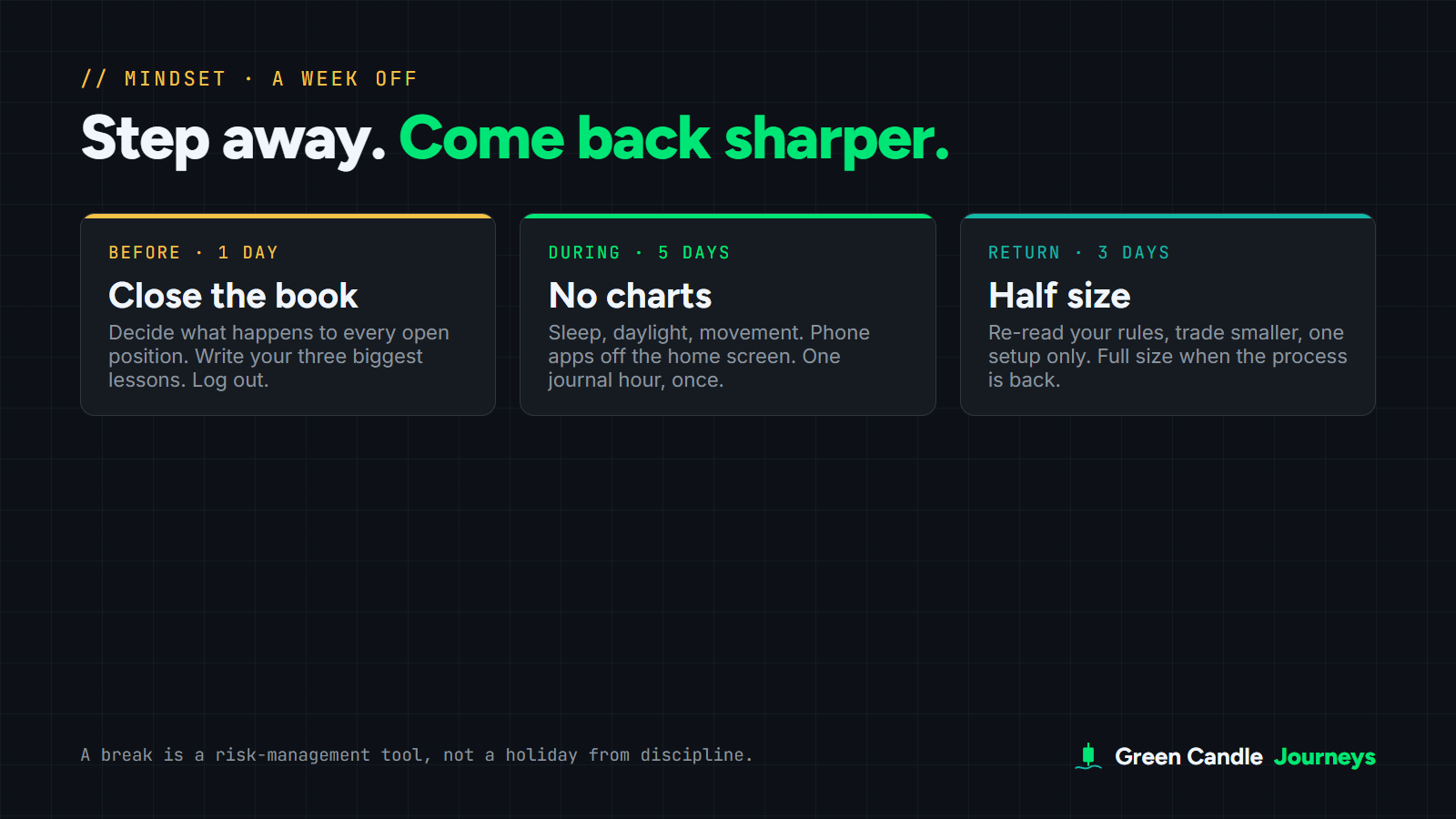
Close the book: decide what happens to every open position, write down your three biggest lessons from recent trades, then log out of every platform.
- Open positions: go through them one by one. Close, reduce, or leave with a stop you're comfortable never checking. This is about removing anything that needs you, not a trade call.
- Pending orders: cancel anything you won't be watching.
- Automation: if EAs or copy trades keep running, decide that consciously and set limits. Our trading while travelling checklist covers VPS and risk limits.
- Three lessons: one sentence each. You'll read them on the way back.
- Log out: platforms, broker apps, trading chats. Turn off price alerts.
What does a week without charts look like?
Full mornings, no screens, early nights. The aim is to replace the trading routine with another one, so the urge to check has nowhere to go.
| Day | Morning | Afternoon | Evening |
|---|---|---|---|
| 1 | Sleep in, long walk | Something physical | Phone away by 22:00 |
| 2 | Sunrise swim or run | Explore somewhere new | Dinner with people, not screens |
| 3 | Early activity | The one journal hour | Early night |
| 4 | Day trip | Day trip | Rest |
| 5 | Slow morning | Re-read your three lessons | Plan the return |
The hardest hours are the ones when your session usually opens. Book something for exactly then. In Vietnam that's easy, because London opens at 15:00 and New York at 20:00: an afternoon in Hoi An's old town or a sunset on the beach fills the gap.

How do I come back without overtrading?
Many traders return over three days: rules re-read first, smaller size, one setup only, and full size once they're following their process again rather than chasing the week they missed.
- Day 1: read your rules and the three lessons. Watch the open without trading, or trade the smallest size you use.
- Day 2–3: one setup, reduced size, a hard daily loss limit.
- Then: back to normal size when you've followed the plan for a few sessions in a row.
The urge after a break is to make up for lost time. That's the same urge that makes revenge trades, so treat it the same way. Session times for your return are in forex market hours in Vietnam and our country guides.
Where should a trader take a week off?
Somewhere your mornings are full and your sessions land at inconvenient times to check. A different time zone helps, and so does a place with more to do in daylight than at night.
Da Lat's cool pine forests, Hoi An's old town and the beaches of Da Nang all work, and Vietnam's UTC+7 means the sessions you're avoiding fall in the afternoon and evening. Our sister site's Da Lat guide and things to do in Hoi An are good places to start, and Hoi An or Da Nang for traders helps you choose a base.
FAQ
Is it good to take a break from trading?
For many traders, yes. Constant screen time, late sessions and a run of losses wear down decision-making, and a planned break gives you distance to review your process. The key word is planned: decide what happens to open positions and how you'll come back before you stop.
How long should a trading break be?
A week is long enough to sleep properly and see your trading from the outside, and short enough not to lose your routine. Some traders take a long weekend every month and a full week once or twice a year.
What should I do with open positions before a break?
Decide in advance, position by position: close it, reduce it, or leave it with a stop you're comfortable never checking. What matters is that nothing is left needing your attention. This is a process choice, not a trade recommendation.
Will I lose my edge if I stop trading for a week?
Your edge lives in your rules and your process, which don't disappear in a week. What can slip is execution and timing, which is why many traders come back at smaller size for a few days before returning to full size.
How do I stop checking charts on holiday?
Make it harder: log out of platforms, move apps off the home screen, turn off price alerts, and give yourself one planned journal hour instead of constant checking. Being busy in the morning helps more than willpower.
The bottom line
Plan the week off like a trade: close the book the day before, five days with no charts, three days back at smaller size. Your edge is in your rules; the break is what lets you follow them again.
Next: the signs of trader burnout, or how to trade while travelling when you're ready to bring the laptop back out.
This is about routine and wellbeing, not trading advice. We sell travel, not signals, and we never promise trading results.